Technology leaders are assuming new responsibilities for maintaining cloud environments. This article highlights three out-of-the-box (OOTB) cloud monitoring toolsets available from the major cloud providers: Amazon Web Services (AWS), Microsoft Azure (Azure), and Google Cloud Platform (GCP). These provider tools can assist utilities in managing their environments across two key areas: Observability and Telemetry, and Security and Compliance.
Conventional on-premises GIS infrastructure environments can pose management challenges for utilities. These challenges often stem from a shortage of GIS expertise among IT staff and the limited availability of monitoring software for administrators. For these reasons, many utilities are increasingly adopting cloud solutions to support and modernize their GIS infrastructures. Cloud solutions can provide instant observability, streamline environment management processes, produce detailed performance metrics, and easily generate associated system log files.
Technology leaders are assuming new responsibilities for maintaining cloud environments. In response, many cloud providers offer OOTB tools that can help technology leaders effectively monitor their cloud environments with ease. By leveraging these readily available tools, utilities can holistically monitor and manage the health and security of their systems.
GIS Environment Management and Cloud
GIS environment management has historically been an internal process that relies solely on the expertise and experience of an organization’s infrastructure support team. The success of this process is closely linked to the number of support resources available within the organization.
This can present challenges, as support teams may have limited exposure to GIS or may lack direct experience in supporting GIS infrastructure. Managing the configuration of monitoring tools across various systems within the organization can also be difficult. Additionally, many utilities can face delays due to challenges in software procurement and difficulties in deploying tools across various components that have been pieced together to support the on-premises GIS environment.
Moving to the Cloud
Cloud has further evolved the traditional management challenges. It’s no longer enough to have either monitoring tools or subject matter experts. Successful management of a GIS cloud environment requires both elements to work in concert. On top of that, teams managing GIS environments must be comfortable working with cloud technology and have GIS experience under their belts.
Organizations moving to the cloud must consider all historic responsibilities, including integration and configuration requirements from their legacy systems. They should establish key performance indicators (KPIs) to evaluate how effectively their cloud environments support business operations. It’s essential to go beyond merely tracking performance and availability metrics to fully understand how the cloud enables agility in managing day-to-day operations. It will be important to document the speed at which new resources can be spun up and deployed in response to business needs. In that same vein, tracking periods of low usage is vital to minimize the number of active resources and ultimately reduce monthly cloud costs.
Many OOTB cloud tools can help establish these baseline performance metrics, which can assist in creating maintenance standards and shaping best practices for GIS teams. These tools also help expedite the environment monitoring process, allowing the infrastructure and GIS teams to focus on more high-value tasks, such as configuring the monitoring tools to suit their organizations’ unique business needs. A failure to use these tools can introduce significant business risks, as unattended cloud environments may experience performance issues that limit functionality, create bottlenecks, and hinder day-to-day operations. Errors and other undocumented changes can also lead to a drastic increase in monthly cloud costs for the utility.
Cloud Monitoring Tools by Provider
Cloud providers understand the criticality of effective environment management and have created various monitoring tools as part of their cloud subscriptions. These tools offer utility organizations a window into critical operational information in real time, including the status, performance, and changes within their cloud environments. These tools can help technology leaders generate detailed environment metrics more quickly.
These monitoring tools are also instrumental in gathering the telemetry—remote data collected and processed in a central location—needed to document performance and reporting metrics related to the following KPIs:
- Performance: network latency, central processing unit (CPU) utilization, memory utilization
- Availability and Reliability: mean time to recovery (MTTR), mean time between failures (MTBF), failover success rate, service availability/uptime (%)
- Cost Efficiency: idle resource percentage, rightsizing savings/cost avoidance, cloud spend vs. budget
- Scalability: auto-scaling, environment elasticity, provisioning time
- Security and Compliance: incident security tracking, backup status, compliance patching, rate, identity and access violations
- User Experience: service-level agreement (SLA) compliance, application response times, error logging
- Operations and DevOps: deployment frequency, change lead time, change failure rate
OOTB cloud tools are available to organizations at no additional cost. However, organizations will need to cover the processing and data storage fees incurred from using these tools in their cloud environments. Without the costs of additional monitoring technology, organizations can reallocate their licensing funds toward training technical staff to configure these cloud-native tools, which can help further optimize environment performance.
While all major cloud providers offer OOTB monitoring tools, each provider has different offerings that may be better suited to your utility’s needs and objectives. All the toolsets are designed to enhance infrastructure security and observability. Now, we’ll take a brief look at some of the tools available from AWS, Azure, and GCP.
AWS Cloud Monitoring Tools
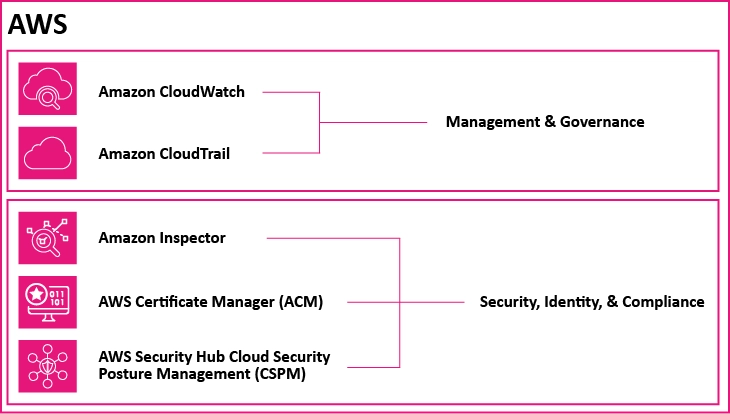
Cloud monitoring tools native to AWS.[1]
|
Usage |
Tool |
Description |
|---|---|---|
|
Observability |
Amazon CloudWatch |
Amazon CloudWatch enhances AWS environment observability by collecting data across the system. Users can leverage this tool to set performance alarms that alert them about environment resource usage/operational health and performance changes. |
|
Telemetry |
AWS CloudTrail |
AWS CloudTrail enhances telemetry by continuously monitoring account actions across your AWS infrastructure and logging those activities. This facilitates the process of analyzing actions that may have affected your environment and taking the necessary remediation actions to address those. |
|
Security |
Amazon Inspector |
Amazon Inspector continuously scans Amazon EC2 instances, container images in Amazon ECR, and Lambda functions for software and network vulnerabilities. When this security tool discovers a software vulnerability or unintended network exposure, it creates a finding—a detailed report about the issue that can be managed via the Amazon Inspector console or API. |
|
Security |
AWS Certificate Manager (ACM) |
ACM is a security tool that enables the creation of both public and private Secure Sockets Layer/Transport Layer Security (SSL/TLS) certificates for internal resources and manages the certificate lifecycle centrally. With ACM, certificates can be requested and deployed on AWS resources (e.g., Elastic Load Balancers, Amazon CloudFront distributions, and APIs on API Gateway). ACM also handles certificate renewals. |
|
Security/Observability |
AWS Security Hub Cloud Security Posture Management (CSPM) |
AWS Security Hub CSPM provides comprehensive observability of the environment’s security state and assists in assessing it against security industry standards and best practices. By collecting security data across AWS accounts, AWS services, and supported third-party products, it helps users analyze security trends and identify the highest priority security issues. |
Microsoft Azure Cloud Monitoring Tools
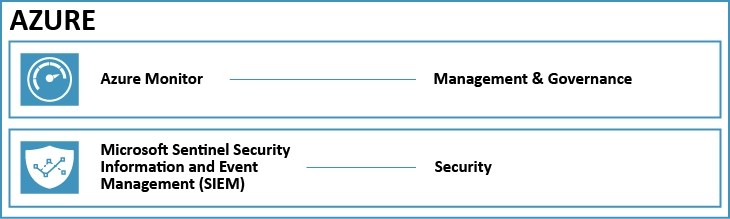
Cloud monitoring tools native to Microsoft Azure.[2]
|
Usage |
Tool |
Description |
|---|---|---|
|
Observability/Telemetry |
Azure Monitor |
Azure Monitor collects and aggregates the data from every component of the cloud environment for logging and reporting. It also integrates with various Microsoft and non-Microsoft tools. The collected is stored in a centralized data platform, allowing administrators and analysts to analyze, visualize, and respond to the data from one location. |
|
Security |
Microsoft Sentinel Security Information and Event Management (SIEM) |
Microsoft Sentinel is a cloud-native solution that offers security content packaged in Security Information and Event Management (SIEM) solutions. It provides scalable, cost-effective security for both multicloud and multi-platform environments. Microsoft Sentinel leverages AI, automation, and threat intelligence to support threat detection. Organizations can ingest data, monitor activity, and configure alerts to proactively hunt and address security vulnerabilities in their cloud environments in a timely manner. |
Google Cloud Monitoring Tools
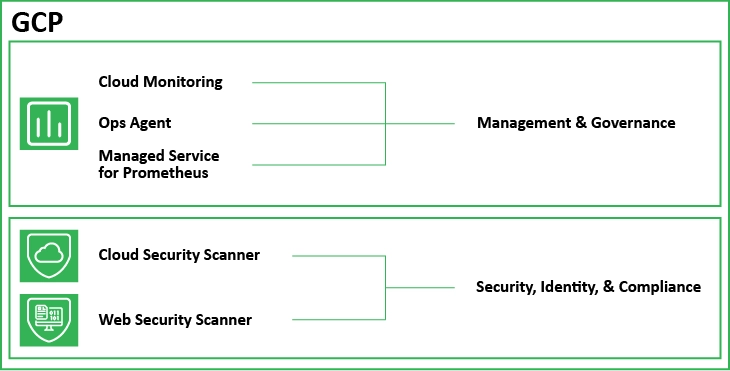
Cloud monitoring tools native to Google Cloud Platform.[3]
|
Usage |
Tool |
Description |
|---|---|---|
|
Security |
Cloud Monitoring |
GCP’s native observability service that collects and aggregates performance metrics, system events, and metadata from Google Cloud resources, third-party applications, and hybrid environments. It provides real-time dashboards, threshold-based alerting, and uptime monitoring to help organizations maintain application health and monitor the performance of their cloud environments.. |
|
Observability |
Managed Service for Prometheus |
Managed Service for Prometheus provides scalable monitoring for Prometheus workloads by leveraging Google’s Monarch time series database and Site Reliability Engineering (SRE) expertise. It integrates with Cloud Monitoring to provide a unified view of Prometheus and Google Cloud metrics, supporting dashboards, alerting, Service Level Objective (SLO) monitoring, and PromQL. The service also offers managed collectors and Ops Agent integration while supporting existing self-managed Prometheus collectors for flexible deployment. |
|
Observability |
Ops Agent |
The Ops Agent is Google Cloud’s unified telemetry agent for Compute Engine that collects logs, metrics, and traces through a single installation. It automatically collects system logs and metrics, supports Prometheus and OpenTelemetry data, and integrates with common third-party applications to simplify observability across cloud environments. The Ops Agent also helps organizations optimize observability costs by providing visibility into metric usage and allowing unnecessary metrics to be excluded. |
|
Security |
Cloud Armor |
Google Cloud Armor protects applications from distributed denial-of-service (DDoS) attacks and common web threats such as SQL injection (SQLi) and cross-site scripting (XSS) through configurable security policies, custom rules, and preconfigured web application firewall (WAF) rules. Cloud Armor Enterprise extends this protection with always-on Layer 3 and Layer 4 DDoS mitigation, configurable Layer 7 protection, and features such as Google Threat Intelligence and Adaptive Protection. By filtering malicious traffic at Google’s network edge, Cloud Armor helps secure applications deployed in Google Cloud, hybrid, and multi-cloud environments. |
Optimizing with Cloud Monitoring Tools
The increasing adoption of cloud technology has shifted the responsibility of managing cloud environments to technology leaders at many utility companies. By using OOTB cloud monitoring tools, these leaders can effectively monitor their cloud environments, reduce overhead costs, document telemetry with ease, and simplify the management of their GIS infrastructures. As native offerings provided by cloud providers, these monitoring tools are easily configurable, provide a holistic view of the environment, and offer a cost-effective approach to meeting your organization’s GIS environment management needs.
Footnotes
1. Amazon AWS, https://aws.amazon.com/cloudops/monitoring-and-observability/, 2026.
2. Microsoft Azure, https://azure.microsoft.com/en-us, 2026.
3. Google Cloud Monitoring, https://cloud.google.com/monitoring, 2026.