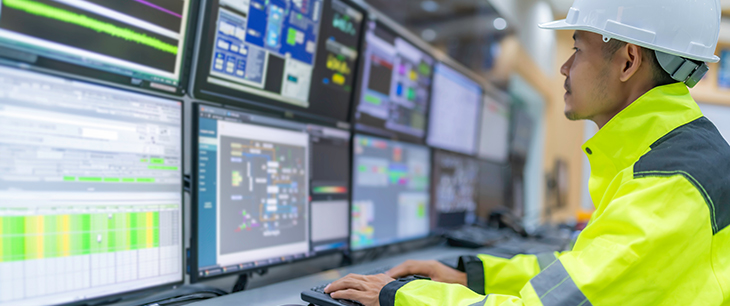
GIS is a great technology fit and has the capability to add value to the day to day work of the Utility Operations Team. Providing value to Operations takes more than what a standard KPI reporting dashboard can deliver. Gaining true operational business intelligence and insight requires being able to see the performance of operational systems on a realtime basis and providing a “digital twin” that mirrors the performance of these systems so that systems can be managed. GIS provides for a single aggregated view and business intelliegence of the operational systems environment versus monitoring the outputs of the individual systems.
Not all Dashboards are Created Equal
Dashboards are a means of getting information to their users and presenting it in a manner that is digestible and actionable for the user; however, not all dashboards can be classified as operational, and even fewer are truly dynamic or analytic in their data visualization and spatial filtering capabilities. To understand how operational dashboards are delivering value for Utility Operations Teams, it is relevant to discuss the different types of dashboards and their functions.
There are three primary types of business reporting dashboards:
- Strategic (KPI) dashboards are often viewed by executives and assist to track the overall health of the organization by reporting on key business performance metrics.
- Analytical dashboards are focused on identifying and tracking trends, often long term, to help predict outcomes and future business needs and improve business processes.
- Operational dashboards monitor constantly updating business processes and are most effective when presented in real-time giving a consistent ‘as-operating’ view empowering the business to quickly address challenges or opportunities.
See Emergency Response and the Operational Digital Twin: Cleco’s Dashboard Solution and Digital Twin Technology at Cleco to learn how Cleco is using operational digital twin technology and dashboards to better manage outage operations and communications.
GIS Enablement of Ops Dashboard Technology
The recent advances in Esri® ArcGIS® Enterprise architecture have made it possible for UDC to build an event driven Dynamic Analytic (DyAN) “digital twin” reporting environment. We were able to develop a GIS Portal Dashboard framework that includes business intelligence indicators and drill downs to support the needs of those who want to see how their power system is behaving. This event driven architecture is based on Esri’s Web AppBuilder (WAB) and UDC’s value add.
DyAN™ is a dynamic hybrid of analytic and operations dashboards supporting integrations with Operational Technology (OT) systems such as OMS, DMS, ADMS, DSCADA, PI, EMS, AMI, MDMS, DRMS and DERMS being deployed to better manage the power system. These OT systems are great at managing aspects of the power system but are not the ideal architectures to base your data marshalling and operational communciations infrastructures on. The ArcGIS Enterpise platform brings a solid enterprise architecture for communicating with internal and external stakeholders as well as with the field.
DyAN™ – Key Differentiators for Utilities
We get asked all the time: “What does this do that I don’t already have?”
For starters, UDC’s DyAN™ framework brings a new level of dynamic to GIS based dashboards and provides a level of support to perform operational work that goes beyond KPI reporting dashboards. We can consolidate six or more dashboards, that our clients typically have today in OT systems, into one sustainable framework. As a hybrid dashboard offering, some DyAN™ dashboards support the operational communications needs while others support the historical reliability engineering and asset management needs within a single application.
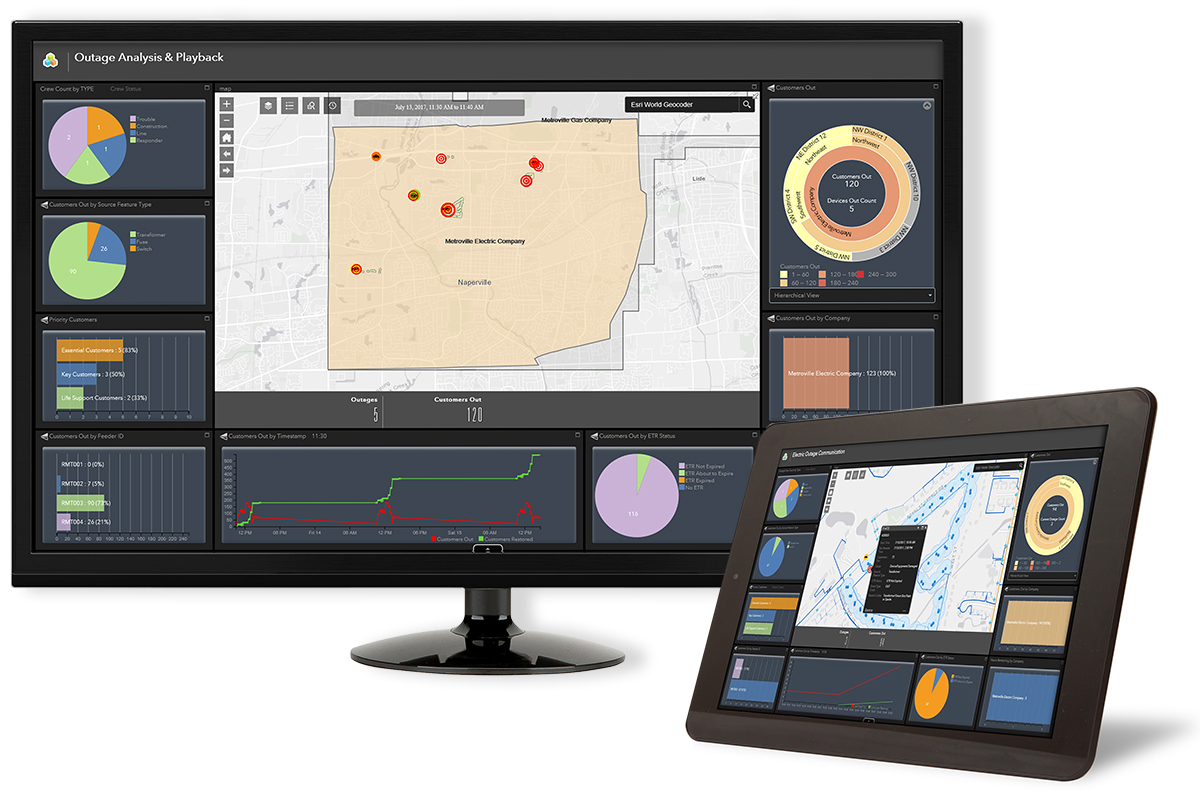
The framework uses Esri ArcGIS Enterprise, so we have a robust enterprise infrastructure to support internal, external and field stakeholders. Many utilities use different systems for these functions currently and do not have the capability to present a ‘digital twin’ operating view for internal and field users.
The DyAN™ framework can be stood up quickly to support one or two operational systems first: Outage Management and Mobile Workforce Management and has been designed to scale and integrate with PI, AMI, MDMS, ADMS and distribution planning systems.
Reliability Engineering Support
Going beyond outage communications, DyAN™ supports Reliability Engineers to see their forecasted reliability simulations on top of historical power network behavior within a reliability engineering dashboard. Operations Teams benefit from the business Intelligence (BI) power of aggregation and drill down to see large amounts of data quickly and then drill down to see root causes in various operational systems.
DyAN™ offers many other unique capabilities for utility operations:
|
Unique Capabilities of DyAN™ | ||
|
– |
Fully Dynamic – DyAN™ users do not have to click their mouse or display to show them the current state of power system. The view is continuous and a true Digital Twin. | |
|
– |
Intuitive Interface – Click on one widget and all related widgets update and refresh, as does the map display and the map mashups. No action is needed to get maps to refresh. | |
|
– |
No need for trace of Outage events – OMS integrations use actuals from OMS to show both outage and outage extents. DyAN™ assumes OMS is the system of record (SOR) for outage events, customers out, outage ETRs and outage isolation and restoration manual switch steps. | |
|
– |
Digital Twin Mirroring – Dashboard mirrors both OMS manual switching steps, OSIsoft PI System managed automated switching steps and PI managed telemetered status such as FCI status and cap bank status. | |
|
– |
As-Operating Views – DyAN™ shows only Real Outages (SCADA or human confirmed) and Predicted Outages that have aged for a more consistent view. | |
|
– |
OSIsoft® PI System® integration is event driven vs. only for a given time period. | |
|
– |
ADMS integration shows fault locations as generated by ADMS software and confirmed by operator or the field technician vs. reported distances from IED devices. | |
|
– |
DyAN™, through relating to all OT systems vs. just AMI/MDMS, allows actual grid configuration at time of power quality issues. This allows proactivity in addressing the power quality issues that new DER devices may be causing on the distribution grid. | |
|
– |
Supports internal, external and field operational communication views using the power of ArcGIS Enterprise. Typically, these three views have required separate systems and a synch. | |
|
– |
DyAN™ architecture provides Feeder Sentinel views for reliability engineering to look at: • Operating History • Forecasted Grid Behavior • Current Behavior Typically, it has been required to go to different systems to provide historical operating behavior. |
UDC brings the dynamic operational dashboard experience as well as the integration expertise with all of the major OT vendors including OSIsoft® PI System®. Contact us to learn more about operations dashboards for your utility or visit the DyAN™ solution page of our website.