Many utilities are exploring the role of artificial intelligence/machine learning (AI/ML) in grid management. From employment as a ‘digital coworker’ to assisting with recordkeeping, AI is being considered. What about when it comes to day-to-day grid operations? In this article, UDC Executive Consultant Tom Helmer shares research and insight regarding the application of AI/ML in the electric distribution operations center.
Content Overview

ADMS: The Foundational Technology
As I researched the use of AI/ML in the distribution operations center, I ran across articles promoting the changeover from advanced distribution management systems (ADMS) to AI. I came across some misconceptions regarding the functionalities already available within a modern ADMS. Many articles conflated the ADMS’s volt/var optimization (VVO) functionality with volt/var control (VVC) and conservation voltage reduction (CVR) functionalities. They discussed what VVC and CVR bring to the table,[1] while ignoring the advantages that VVO offers. VVO provides significant capabilities to the distribution operations center by examining the current as-operating model and generating optimal plans based on the actual load, potentially being provided by advanced metering infrastructure (AMI) bellwether meters and/or line sensors installed along feeders; it isn’t based on a static or heuristic model.
For VVO to run in a closed loop and effectively minimize the energy injected into the system, it’s crucial to update the utility’s business processes to support ‘zero data latency’, or real-time data exchange.[2] This ensures that the ADMS is using the latest near-term or scheduled proposed changes in the as-operating network configuration, thus providing accurate, current data to its other applications. To take advantage of the closed-loop optimizing applications of the ADMS, such as power-flow, switch order management (SOM), fault location isolation and service restoration (FLISR), and VVO, it is crucial to streamline the utility’s business processes for new construction work—including Design, Field As-builting, Backoffice As-builting, and ADMS Model Build Processing—to support ‘zero data latency’.
I came across many articles that discussed the role of AI/ML in helping with the generation of digital twins, but none recognized the role of ADMS as the system of record for the as-operating digital twin. When properly deployed and maintained, the ADMS supplies the digital twin with access to a ‘zero data latency’ network configuration, readings from line sensors, and bellwether meters. It further enables remote telemetry and control of distribution devices, including load tap changers (LTCs), voltage regulators, capacitor banks, circuit breakers, switches, reclosers, sectionalizers, and batteries.
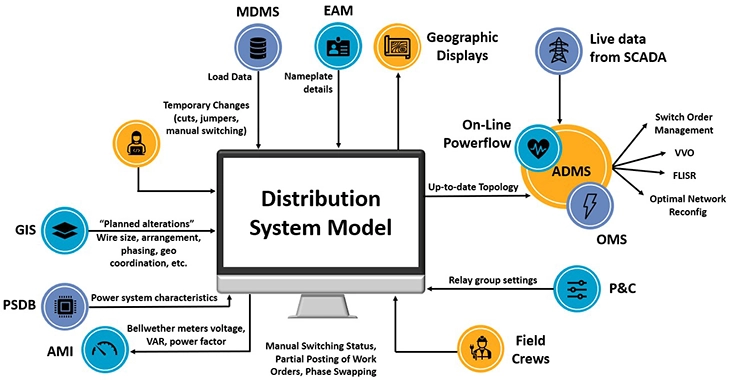
While AI/ML is the new shiny toy on some utility wish lists, ADMS is the foundational system for grid operations upon which AI can enhance. AI initiatives should, therefore, be designed to augment an established, operational ADMS. Once utilities have an operational ADMS and have fully tapped into the system’s enabled applications, they are well-positioned to explore and pilot AI technology.
Key ADMS Applications
To be fair to the advancements of what a modern ADMS can bring to the operations center, the comparisons should be made with the fully ‘optimized’ ADMS applications that are leveraging a current as-operating model that includes all relevant telemetry information. This enables a fair comparison of ADMS functionality with AI/ML applications used in the operations center.
Below are some of the ‘optimized’ applications enabled by ADMS.
Switch Order Management (SOM) utilizes the as-operating model, along with information from line sensors and AMI bellwether meters. These inputs enable the application to optimally generate switching orders that can redirect load to tertiary feeders. These optimizations are based on the as-operating conditions of all related feeders. ADMS provides a solution for optimally creating switching orders that rebalance and shift load while maintaining protection and control coordination. SOM also takes into consideration the need to potentially issue changes to relay settings before issuing switching order steps to ensure the network stays well protected.
In addition to generating orders based on the current as-operating network model, SOM can also create orders for future periods, taking into account weather forecasts and AMI-correlated loads.
Fault Location Isolation and Service Restoration (FLISR) is another optimization application found in most modern ADMSs. By its definition, it needs to restore service in less time than what constitutes a ‘real’ outage event—either 1 minute or 5 minutes, depending on the state in which the outage occurs. This means FLISR must operate in under a minute to provide value across the United States.
FLISR requires an accurate network model and information from higher-end fault circuit indicators (FCIs) installed along the feeders and substation relays. These relays and line devices can detect faults within tens of milliseconds of their occurrence. FLISR can, therefore, quickly detect a fault location and subsequently generate and complete both its isolation switching order and its restoration switching order(s).[3] Given this rapid response time, the question arises: how much faster could AI/ML applications truly enhance FLISR functionality?
Distribution State Estimator (DSE) improves all advanced ADMS applications built on power-flow results and is enhanced with the supplemental telemetry information along a feeder.
How ADMS Enhances AI/ML Operational Applications
Many articles aim to compare ADMS results with those from AI/ML for grid operations. It’s important to reemphasize that the as-operated models maintained by the ADMS, along with certain telemetry data, are fundamental to the results produced by AI/ML grid operating applications.
AI is only as good as the data feeding it.[4]
UDC believes that extending the value proposition of a well-deployed ADMS with additional AI/ML grid-operating functionality is worth piloting for the initial ADMS and AI/ML ‘comparison’ results. However, this comparison won’t be a 1:1, as some articles claim, as the dependence of AI/ML applications on the information provided by an ADMS isn’t factored into the equation. Still, the reported operational improvements of 100% to 200% are impressive and support the business case for a pilot project to explore the benefits of AI/ML applications. Keep in mind that the pilot will only deliver true value if the applications are fed by an operational ADMS.
As mentioned previously, one noteworthy use case for AI/ML is FLISR. Given ADMS’s rapid speed with the appropriate line devices installed, one could pilot the configuration and deployment of ADMS against the AI/ML FLISR to see whether it can indeed achieve a 100% improvement in performance.
Similarly, AI/ML improvements for VVO claim a 200% increase in injected energy savings compared to a well-deployed ADMS that uses line sensors and bellwether meters.[5] By nature, VVO is a slow-moving application. Adjustments to LTCs, capacitor banks controllers, and voltage regulator settings are managed effectively by the ADMS’s VVO application in a closed-loop fashion with a periodicity of 15 to 20 minutes. The VVO approach within the ADMS is designed to be adaptive.
How AI/ML Forecasting Enhances ADMS Applications
Today’s AI/ML weather forecasting models are quite good. These models rely on cloud computing resources, which may not be available in an on-premises ADMS. Incorporating AI/ML weather forecasting applications can significantly enhance the ADMS applications that leverage weather forecasting information—namely, distributed energy resources (DERs) and SOM.
AI/ML can enhance the forecasting of DERs behavior and impacts for both distribution power system optimizations and market or economic optimizations. AI/ML can act as the orchestrator of DERs by helping to detect, categorize, enroll, and optimize these resources—balancing supply and demand and improving grid efficiency, decarbonization, and energy affordability. AI-driven automation supports real-time DER dispatch, increasing flexibility and market participation.
There has been significant investment in improving load forecasts using historic information from AMI. All ADMS applications built on top of unbalanced power-flow will benefit from enhanced load forecasting provided by AI/ML load forecasting applications. While the meter data management system (MDMS) collects meter interval data at 15-minute intervals, which provides a good forecast of demand for any given day or interval during the year, AI/ML can further refine the loads with weather forecast impacts that the MDMS interval information does not capture.
Other ADMS applications that are enhanced by weather and load forecasting information include:
- Outage Management – outage prediction and storm impact analysis, tree-related outages
- FLISR – similar to SOM in using weather to generate switching orders
- Microgrid Control & Islanding – loads based on weather; improves survivability of islanding decisions
- Fire Management – creating public safety power shutoff (PSPS) events
- Demand Response – creating events
Bringing the power of cloud-based AI/ML forecasting capabilities to ADMS’s advanced applications is a great use case for the operations center to begin adopting these technologies.
Typical ADMS Roadmap for AI/ML Technology Adoption
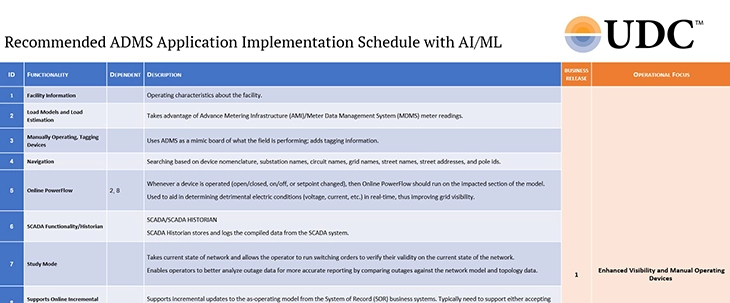
In UDC’s previous article, Ordering of ADMS Applications by Functionality, Value, and Technical Dependencies for Optimal Deployment, we discussed subdividing the ADMS and Digital Grid Data Repository (DGDR) applications into six groupings or business releases to form a high-level roadmap. This roadmap has been augmented to incorporate the AI/ML functionality through the addition of two more business releases.
UDC’s Recommended ADMS Application Implementation Schedule with AI/ML Functionalities includes 55 applications, along with their descriptions, dependencies, and recommended business release and implementation ordering. This order is designed to follow a logical and progressive sequence where each business release is contingent upon the previous one(s), with exception of creating the DGDR in the third business release. Additionally, it is important to note that most advanced applications rely on Online PowerFlow (Functionality 5) or Short Circuit Analysis (Functionality 22) as a foundational requirement.
UDC recommends subdividing your utility’s advanced ADMS applications into the following eight business releases to incorporate AI/ML technology adoption:
- Enhanced Visibility and Manual Operating Devices
- Daily Operations and Trouble Response
- Automating IED Data Collection and Populating DGDR
- Optimization and Automating Device Operations
- Adding Asset Management Applications to Use the DGDR
- Adding AI/ML Asset Management Applications to use the DGDR
- Micro Grid Management
- Pilot the AI/ML VVO, FLISR, and Micro Grid Management applications using the ADMS as-operating model
AI Success Starts with the ADMS
Based on our industry knowledge and research into this emerging digital landscape, UDC views AI/ML technologies as complementary to an already well-deployed ADMS—not as a replacement technology for grid operations—contrary to some of the hype. We believe AI/ML can help enhance the already established predictive analytics available within the ADMS’s optimized applications by incorporating the technology’s weather and load forecasting models—as part of the initial deployment of the ADMS advanced applications discussed in this article.
An operational ADMS is fundamental for leveraging many AI/ML applications and for utilizing AI’s forecasting applications from day one. Once the ADMS is fully operational, utilities can leverage the 100+ advanced applications that modern ADMS platforms offer, requiring only the investment in training for grid operators.
Once the full power of the ADMS is realized, utilities are well-positioned to explore how AI/ML operational applications can be integrated into the operations center.
Learn more about UDC’s ADMS implementation and consulting services.
Footnotes
1. IEEE Xplore, https://ieeexplore.ieee.org/document/8783101, dated 08 2019
2. IEEE Xplore, https://ieeexplore.ieee.org/document/11097985, dated 08 2025
3. Energie NB Power, https://www.nbpower.com/en/grid-modernization/conservation-voltage-reduction-cvr-research-and-demonstration-pilot-project/, dated 06 2021
4. Fast Company, https://www.fastcompany.com/91180070/ais-golden-rule-good-data-inputs-better-ai-outputs, dated 08 2024
5. Bain & Company, https://www.bain.com/insights/zero-based-redesign-the-key-to-realizing-gen-ai-cost-savings-potential/, dated 08 2024